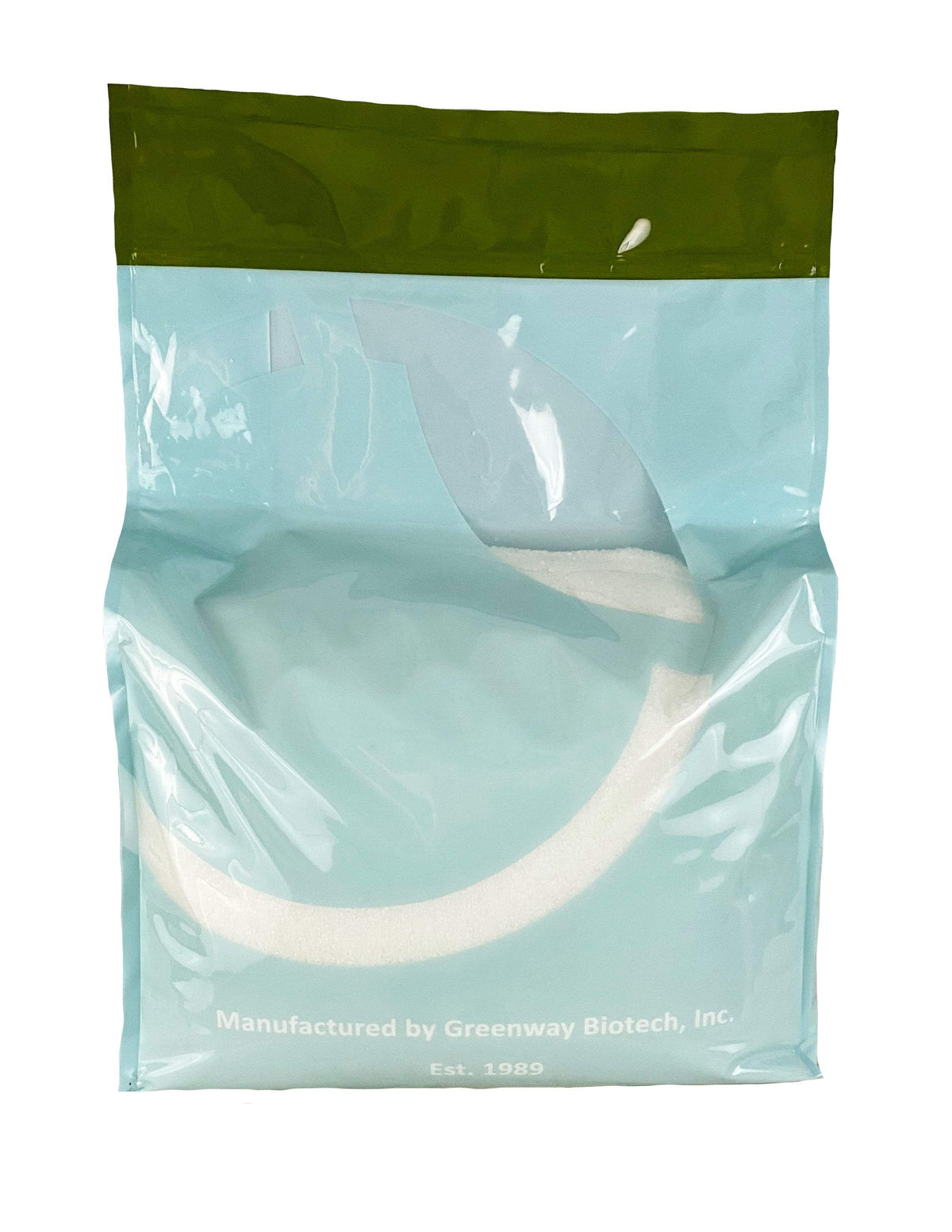
Fast-acting ammonium calcium nitrate with 15.5% nitrogen and 19% calcium. 100% water-soluble formula can significantly reduce blossom end rot, strengthen cell walls, and deliver dual-nutrient efficiency for soil, hydroponic, and foliar applications.
Delivers immediately available Ca²⁺ ions that reinforce cell walls, can help prevent blossom end rot in tomatoes and peppers, and may reduce tip burn in lettuce and brassicas.
Combines fast-acting nitrate nitrogen with ammonium nitrogen for both immediate green-up and sustained vegetative growth. Ammonium is converted by soil microbes over days to weeks, extending the feeding window.
Dissolves completely with zero residue for uniform nutrient delivery through drip irrigation, foliar sprayers, hydroponic reservoirs, and watering cans.
Has minimal impact on soil pH under normal use — unlike ammonium sulfate, which acidifies, or lime, which raises pH significantly. Allows for routine applications without constant pH correction in most soils.
Provides both nitrogen and calcium in a single application — eliminating the need for separate calcium supplements when nitrogen feeding is also required.
Zero phosphorus prevents environmental P loading and runoff concerns. Ideal for regions with phosphorus application restrictions or waterway-adjacent properties.
Third-party laboratory tested for heavy metal content, with results consistently well below required limits. Commercial-grade quality trusted by professional growers and agricultural operations.
The 19% calcium content directly addresses the calcium transport deficiency that contributes to BER in tomatoes, peppers, cucumbers, squash, melons, and eggplant. Consistent watering is equally important.
Effective in soil gardens, raised beds, containers, NFT, DWC, ebb and flow, drip-to-waste, and aeroponic systems. One product for a wide range of growing methods.
Registered with the California Department of Food & Agriculture. Manufactured in the USA since 1989 to commercial-grade specifications.
Calcium nitrate is a synthetic, water-soluble salt manufactured by reacting calcium carbonate (limestone) with nitric acid. The resulting compound — ammonium calcium nitrate — provides two essential plant nutrients in a single, highly pure crystal.
Ca(NO₃)₂·NH₄NO₃ — provides 15.5% nitrogen (as nitrate and ammonium) and 19% calcium (as Ca²⁺). Fully water-soluble inorganic salt.
This formula combines two of the most in-demand plant nutrients — nitrogen for growth and calcium for structural integrity — in a single, immediately available package. The nitrogen is split between nitrate (fast-acting) and ammonium forms; soil microbes convert ammonium over days to weeks, extending the feeding window across growth stages.
Drives chlorophyll production, protein synthesis, and vegetative growth. The nitrate fraction is immediately plant-available, while the ammonium fraction extends feeding as soil microbes convert it to nitrate over time.
Essential for cell wall formation, cell division, and nutrient transport. Supplying Ca²⁺ directly to developing tissues can help prevent blossom end rot, tip burn, and bitter pit where demand is highest during rapid fruit expansion.
Dissolves completely in water for uniform distribution. Unlike gypsum or lime, nutrients are immediately available to roots — no waiting for soil microbes or pH-dependent dissolution.
Gypsum and lime take weeks to months to release calcium. Calcium nitrate delivers Ca²⁺ within hours of application — making it the most practical choice when blossom end rot symptoms are already appearing on developing fruit.
Lime raises soil pH significantly. Ammonium sulfate acidifies it. Calcium nitrate has a near-neutral pH effect under normal use, making it suitable for routine applications without regular pH correction in most buffered soils.
One application delivers both nitrogen and calcium. Gypsum provides only calcium with zero nitrogen. This reduces application passes and product inventory for growers managing multiple nutrient needs at once.
Blossom end rot appears as dark, sunken, leathery spots on the bottom of fruits. It's caused by insufficient calcium reaching developing fruit tissue — even when soil calcium levels test adequate. The key reason is that calcium travels through the plant only via the xylem (water-conducting tissue), pulled upward by transpiration. Crucially, calcium cannot move back through the phloem to redirect toward rapidly expanding fruit. This means inconsistent watering, rapid growth spurts, and high humidity can all disrupt calcium delivery to fruit tips, regardless of soil levels. Foliar and fertigation applications of calcium nitrate during fruit development can help bypass this bottleneck by providing a more direct supply.
Results vary with watering consistency, humidity, growth rate, and soil conditions. Maintain even soil moisture alongside calcium applications for best results.
| Feature | Calcium Nitrate 15.5-0-0 | Cal-Mag Plus 2-0-0 | Ammonium Sulfate 21-0-0 | Gypsum |
|---|---|---|---|---|
| Nitrogen | 15.5% | 2% | 21% | 0% |
| Calcium | 19% | 3.2% | 0% | 23% |
| Magnesium | 0% | 1.7% | 0% | 0% |
| Water Solubility | 100% | 100% | 100% | Very low |
| Speed of Action | Immediate | Immediate | Immediate | Slow |
| pH Effect | Near-neutral | Near-neutral | Acidifying | Near-neutral |
| Hydroponic Use | Excellent | Excellent | Limited | Not recommended |
| Best For | BER prevention + growth | RO water + coco coir | Nitrogen + sulfur | Clay soil improvement |
Mix into topsoil or dissolve in water. Always water thoroughly after dry application to move calcium into the root zone.
| Stage | Rate | Frequency |
|---|---|---|
| At Planting | 1-2 lb / 100 sq ft | Once |
| First Fruit Set | 2-3 lb / 100 sq ft | Once |
| Maintenance | 1 lb / 100 sq ft | Every 2-3 weeks |
| Crop | Per Plant | Per 100 sq ft |
|---|---|---|
| Lettuce | 1 tbsp | 1.5-2 lb |
| Cabbage | 2 tbsp | 3-4 lb |
| Spinach | 1 tsp | 2 lb |
| System | Rate | EC Contribution |
|---|---|---|
| NFT / DWC | 1-2 tsp / gal | 0.5-1.0 mS/cm |
| Ebb & Flow | 1.5 tsp / gal | 0.75 mS/cm |
| Drip / DTW | 1 tsp / gal | 0.5 mS/cm |
| Crop | Rate | Coverage |
|---|---|---|
| Tomatoes / Peppers | 1-2 tbsp / gal | 100-200 sq ft |
| Fruit Trees | 2 tbsp / gal | 5-10 trees |
| Vegetables | 1 tbsp / gal | 200 sq ft |
The critical window for preventing blossom end rot is when fruits are walnut-sized — this is when calcium demand spikes. Start calcium nitrate applications at this stage and maintain consistent soil moisture. Inconsistent watering disrupts calcium transport more than low soil calcium levels, because calcium can only travel through the plant via xylem flow driven by transpiration — it cannot be redirected through the phloem once delivered. Mulching 3-4 inches deep helps maintain even moisture between waterings.
Refer to the Safety Data Sheet (SDS) for complete safety information.
Calcium nitrate provides nitrogen and calcium — build a complete nutrition program with these complementary products.
Add potassium for fruit quality, disease resistance, and water regulation. Calcium nitrate provides N+Ca — this completes the K.
EssentialPhosphorus and potassium for flowering and fruiting. Always add to the reservoir separately from calcium nitrate.
RecommendedComplements calcium with magnesium for complete secondary nutrient coverage. Essential for chlorophyll production.
RecommendedPrevent iron chlorosis alongside calcium nutrition. Essential micronutrient for hydroponic systems and alkaline soils.
OptionalAll-in-one calcium, magnesium, and iron supplement. Ideal for RO water, coco coir, and LED-lit grows where Cal-Mag demand is higher.
Calcium nitrate (15.5-0-0) is a water-soluble fertilizer that provides fast-acting nitrogen (as nitrate and ammonium forms) plus 19% calcium as Ca²⁺ ions. It dissolves completely for immediate plant availability and can be highly effective for preventing blossom end rot, strengthening cell walls, and supporting vigorous growth. Learn more in our guide to choosing the right calcium fertilizer.
Calcium nitrate can significantly reduce the risk of blossom end rot in tomatoes, peppers, cucumbers, squash, and melons. Apply when fruits are walnut-sized and continue every 2 weeks during fruit development. Consistent watering is equally important — inconsistent moisture disrupts calcium transport even when soil calcium is adequate, because calcium travels through the plant only via xylem flow and cannot be redistributed once delivered.
Apply at planting for baseline nutrition, then again when fruits are walnut-sized — the critical period when calcium demand peaks. Continue maintenance applications every 2-3 weeks. Also apply after heavy rain (which leaches calcium) or during drought stress (which impairs calcium uptake). For a complete guide on nitrogen timing and sources, see our article on the best nitrogen fertilizers.
Yes. Use 1-2 tsp per gallon for an EC contribution of 0.5-1.0 mS/cm. Always add calcium nitrate to the reservoir first, before phosphate sources — mixing them directly causes calcium phosphate precipitation. Works well in NFT, DWC, ebb and flow, and drip systems. See our complete guide to hydroponic fertilizers.
Calcium nitrate provides immediately available calcium AND nitrogen, dissolves 100% in water, and has a near-neutral pH effect. Gypsum is slow-releasing and better suited for clay soil improvement or long-term calcium building without nitrogen. Lime raises soil pH and takes weeks to release calcium. For rapid deficiency correction, calcium nitrate is generally the most practical choice.
It depends on your needs. Calcium nitrate delivers higher concentrations of both nitrogen (15.5%) and calcium (19%). Cal-Mag Plus provides lower amounts but also includes magnesium and iron — making it well-suited for RO water, coco coir, and situations where multiple secondary nutrients are deficient. Many hydroponic growers use both: calcium nitrate as the primary calcium/nitrogen source and Cal-Mag Plus as a secondary supplement.
Never mix directly with phosphate solutions (MAP, DAP, MKP) — this causes immediate calcium phosphate precipitation. In hydroponics, add calcium nitrate to the reservoir first, then add phosphate sources separately. When using unfamiliar combinations, use separate stock tanks and perform a jar test before injecting into your system. Calcium nitrate is compatible with most other nutrients including potassium sulfate, Epsom salt, and micronutrient chelates when each is fully dissolved in water first.
Tip burn in lettuce, cabbage, and other leafy greens is often linked to insufficient calcium delivery to fast-growing inner leaves. Calcium nitrate applications at 1.5-2 lb per 100 sq ft, or 1 tbsp per gallon as a foliar spray, may help reduce tip burn risk. The nitrate nitrogen also promotes vigorous leaf growth. For more on lettuce nutrition, see our article on the best fertilizer for lettuce.
Calcium nitrate is widely used in orchards to help prevent bitter pit in apples and pears. Apply as a foliar spray at 2 tbsp per gallon, starting at petal fall and continuing every 2-3 weeks through fruit development. Multiple applications spread over the season tend to be more effective than a single heavy application.
Calcium nitrate has a near-neutral pH effect under normal use — it won't acidify soil like ammonium sulfate or raise pH like lime. This makes it well-suited for repeated applications without requiring pH correction in most soils. In hydroponic systems, monitor pH as usual and target 5.5-6.5; calcium uptake is generally optimal in the 6.0-6.5 range.
We stand behind every product with a 90-day money-back guarantee. If you're not completely satisfied with your purchase, contact our team for a full refund — no questions asked.
Our agricultural specialists are available to answer your questions about application rates, compatibility, nutrient programs, and growing strategies. Email us anytime at questions@greenwaybiotech.com.
Check out our full FAQ page or contact our experts for personalized advice.
Couldn't load pickup availability