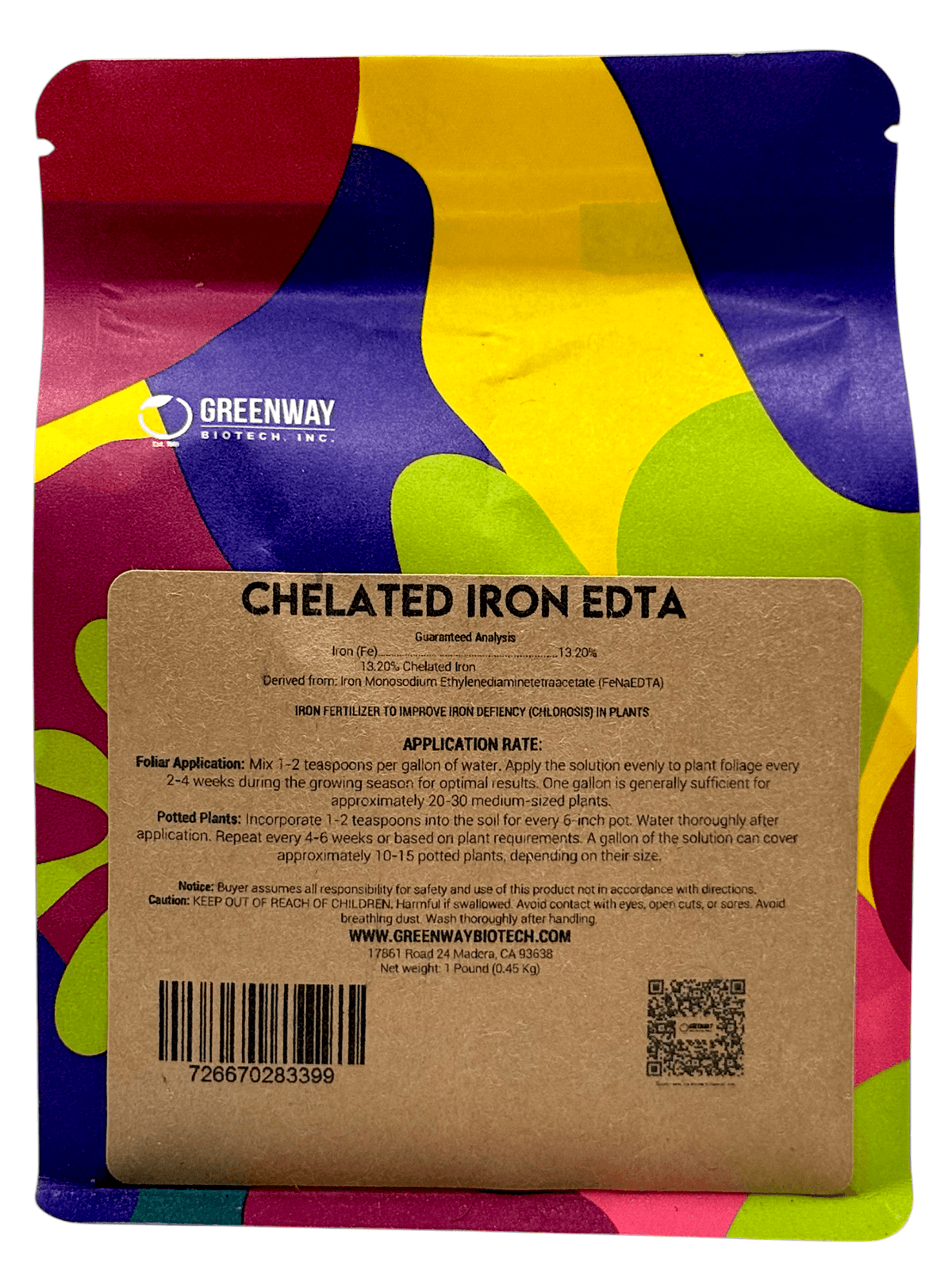
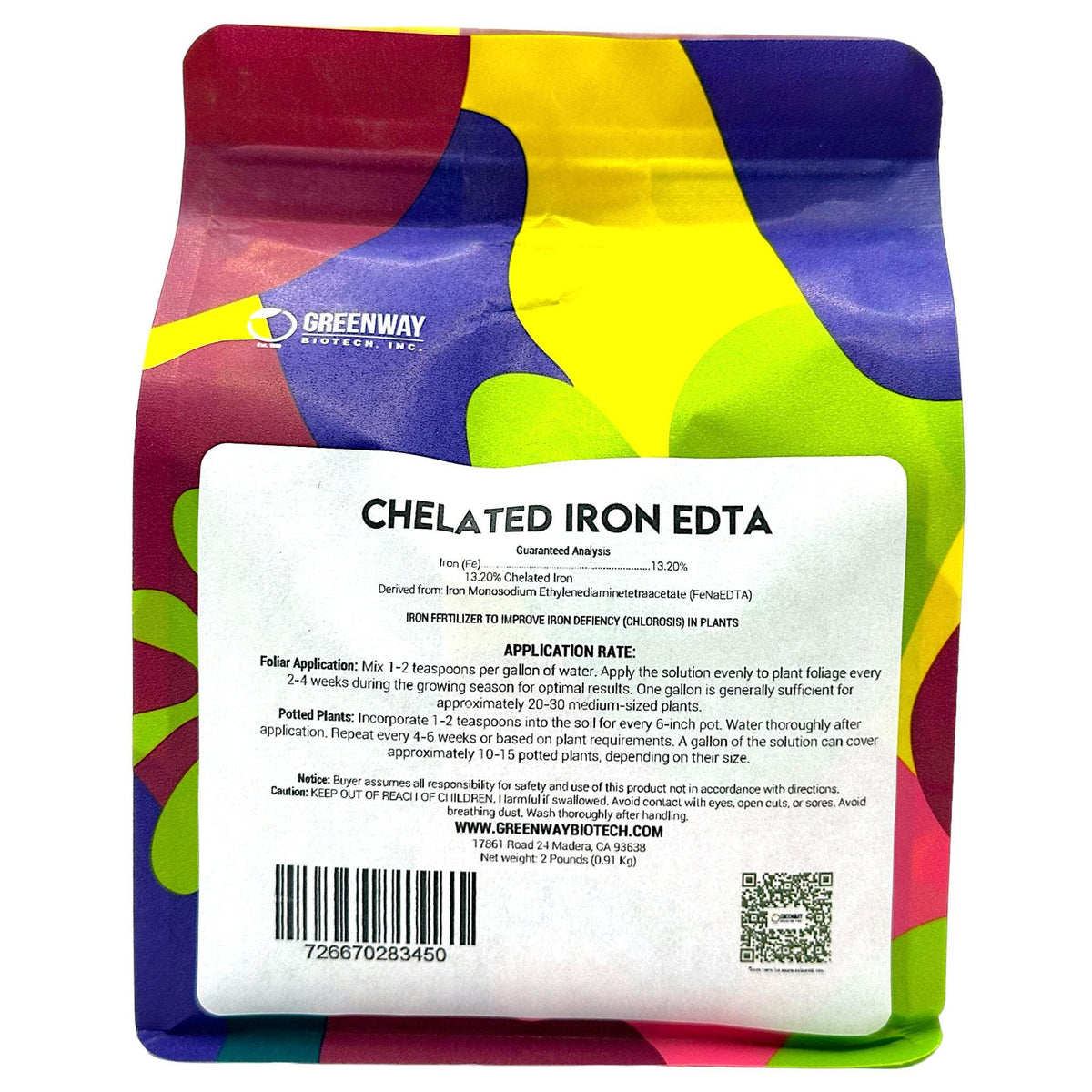
Premium EDTA-chelated iron delivering 13% Fe — one of the highest concentrations available among chelated iron forms. Corrects iron chlorosis fast in acidic to neutral soils (pH 4.0–7.0) for gardens, lawns, and hydroponics.
At 13% Fe, this EDTA-chelated iron delivers more iron per ounce than Iron DTPA (11%) or Iron EDDHA (6%) — fewer applications may be needed to resolve deficiency at pH 4.0–7.0.
Ethylenediaminetetraacetic acid binds iron molecules, preventing them from reacting with soil calcium and phosphates. Iron stays plant-available at pH 4.0–7.0.
Dissolves completely for use in foliar sprays, soil drenches, fertigation systems, and hydroponic reservoirs. No clogging, no undissolved particles.
Many growers notice color change beginning within 3–5 days of foliar application, with significant greening visible in 7–14 days. Results vary with temperature and application method.
EDTA is among the most affordable chelation technologies available. Combined with 13% iron concentration, it can deliver more correction per dollar than other chelated iron forms for pH 4.0–7.0 conditions.
Suitable for foliar spray, root drench, broadcast application, and hydroponic stock solution methods. One product covers every application need where pH is below 7.0.
Registered with the California Department of Food & Agriculture as a specialty fertilizer. Meets all labeling and efficacy requirements for use in California and nationwide.
Independently lab tested for heavy metal content. Results consistently well below required limits — consistent batch quality from our California packaging facility.
Iron is required for chlorophyll synthesis and electron transport in photosynthesis. Correcting iron deficiency directly restores a plant's energy-producing capacity.
Same high-concentration formula trusted by commercial greenhouse operators, hydroponic facilities, and professional landscapers. Made in California, USA.
Chelated Iron EDTA 13% is produced by chelating pharmaceutical-grade iron with EDTA (ethylenediaminetetraacetic acid) under controlled conditions. The result is a pure, dry, highly water-soluble powder with no fillers or carriers.
High-purity ferric iron (Fe³⁺) is the active ingredient, chelated and protected for maximum plant uptake at 13% concentration.
Synthetic chelating agent that forms stable complexes with iron at pH 4.0–7.0, preventing soil precipitation and keeping iron available at the root zone.
Iron is abundant in most soils, but at pH above 6.5 it rapidly converts to insoluble iron oxides that roots cannot absorb. EDTA wraps around iron ions in a stable "cage" structure, blocking reaction with competing calcium, phosphate, and carbonate ions. The chelated iron molecule stays in solution and plant-available until the root releases a natural acid that exchanges the iron from the chelate for uptake. EDTA chelation is effective in soils with pH between 4.0 and 7.0 — the range covering most home gardens, raised beds, and hydroponic systems.
Iron is essential for chlorophyll synthesis, electron transport in photosynthesis, and nitrate reduction. Deficiency causes interveinal chlorosis (yellow leaves with green veins) — the classic sign that plants can't make enough chlorophyll.
Iron sulfate requires very acidic conditions (pH below 6.0) to remain soluble. In neutral or slightly alkaline gardens, it precipitates within hours. EDTA can remain effective up to pH 7.0 for weeks, delivering far more usable iron per application under those conditions.
EDTA chelate delivers 13% Fe versus 11% for DTPA and 6% for EDDHA — which is optimized for extreme pH stability rather than iron concentration. The difference adds up: you may use less product and spend less per correction cycle when your soil pH is in the 4.0–7.0 range.
Once applied, EDTA-chelated iron can remain active in the root zone for 3–4 weeks before the chelate complex breaks down. This can provide sustained correction without the need for weekly reapplication.
Results vary with soil pH, temperature, moisture, and severity of deficiency. Foliar applications act faster than soil applications. Severely chlorotic older leaves may not fully recover — look to new growth for response indicators.
A cost-effective choice for the majority of home gardens, raised beds, container plants, and hydroponic systems. Strong value at 13% iron concentration for the pH 4.0–7.0 range.
For soils testing slightly above neutral (pH 7.0–7.5). Slightly lower iron concentration (11%) but wider pH stability. Step up from EDTA when needed.
For calcareous or very alkaline soils (pH above 7.5). Most expensive chelate; only warranted when DTPA also fails. Lower iron concentration (6%) but extreme pH stability.
Apply early morning or evening when temperatures are below 85°F. pH spray water to 5.5–6.5 for optimal leaf absorption. Add a non-ionic surfactant for improved coverage and penetration.
| Purpose | Rate | Frequency |
|---|---|---|
| Prevention / Maintenance | 1 tsp/gallon | Monthly during growing season |
| Mild Chlorosis | 2 tsp/gallon | Every 10–14 days |
| Severe Deficiency | 1 tbsp/gallon | Weekly until corrected |
| Commercial / Large Scale | 1–2 lbs/100 gallons | Full coverage to runoff |
Dissolve in water and apply directly to the root zone. Soil drenches provide longer-lasting correction (3–4 weeks) than foliar but take 2–3 weeks to show visible results.
| Plant Type | Rate | Frequency |
|---|---|---|
| Houseplants (6" pot) | 1–2 tsp per pot dissolved in water | Every 4–6 weeks |
| Garden Vegetables | 1–2 tbsp/gallon drench | Every 2–4 weeks |
| Ornamental Shrubs | 2–4 tbsp per plant dissolved in water | 2–3 times/year |
| Trees | ¼–1 cup per tree dissolved in water | Spring & fall |
| Lawns | 3–5 lbs/acre | As needed based on appearance |
| Application | Rate | Notes |
|---|---|---|
| Preventive | 1 tbsp/10 sq ft | Water in thoroughly after application |
| Corrective | 2 tbsp/10 sq ft | Repeat every 3–4 weeks until corrected |
Use the stock solution method — direct measurement of powder into reservoirs leads to inconsistent results at the small quantities needed.
| Crop Type | Target ppm Fe | Notes |
|---|---|---|
| Leafy Greens | 2–3 ppm | Lower end of range |
| Tomatoes / Peppers | 2–4 ppm | Increase slightly at fruiting |
| Strawberries | 3–4 ppm | Critical for flavor development |
| Herbs | 2–3 ppm | Standard range |
| Crop | Sensitivity | Special Notes |
|---|---|---|
| Azaleas / Rhododendrons | Very High | Monthly during growing season; acid-loving |
| Gardenias | Very High | Monthly applications; acid-loving |
| Roses | High | Apply at first sign of yellowing |
| Citrus | High | Apply before spring flush; combine foliar + soil |
| Blueberries / Raspberries | High | Critical at fruit set; prefer acidic conditions |
| Petunias / Calibrachoa | High | Weekly foliar in soilless mixes |
For severe chlorosis on roses, citrus, or blueberries, apply both a foliar spray (1 tbsp/gallon) and a soil drench (2 tbsp/gallon) on the same day. The foliar application delivers iron directly to leaves within days while the soil drench builds a sustained root-zone reservoir. Many growers report notably faster recovery with the combined approach versus either method alone.
Refer to the Safety Data Sheet (SDS) for complete safety information.
Iron deficiency rarely appears alone. Build a complete micronutrient program to prevent deficiencies before they affect yield and appearance.
Magnesium is the central atom of chlorophyll. Pair with iron to address both interveinal chlorosis causes — iron and magnesium deficiencies present similarly.
For areas of your garden or landscape where soil pH trends above 7.0. Keep both on hand for consistent results across variable soil conditions.
Zinc deficiency often co-occurs with iron deficiency in alkaline or high-phosphate soils. Tank-mix compatible with iron EDTA for combined correction.
Manganese deficiency mimics iron chlorosis. If iron applications don't resolve yellowing, test for manganese — these two are often confused and co-deficient.
Safe to tank-mix with Iron EDTA in dilute solutions. Provides calcium and nitrogen while iron addresses chlorophyll support — a common hydroponic pairing.
Iron EDTA uses ethylenediaminetetraacetic acid (EDTA) to form a protective "cage" around iron ions. This chelation prevents iron from reacting with calcium, phosphates, and carbonates in the soil — reactions that quickly render unchelated iron insoluble and unavailable to plants. The chelated iron molecule stays dissolved in soil water until a plant root releases a natural acid that exchanges the iron from the chelate for uptake. EDTA chelation is effective in soils with pH between 4.0 and 7.0 — the range covering most home gardens, raised beds, and hydroponic systems. Learn more about essential micronutrients and how chelation works.
Choose EDTA when your soil or media pH is between 4.0 and 7.0 — this is the most common range for home gardens, lawns, and container plants. EDTA is among the most cost-effective chelates and carries a high iron concentration (13%). If your soil pH is 7.0–7.5, switch to Iron DTPA 11%. For very alkaline soils above pH 7.5 — common in parts of the Southwest and on calcareous soils — use Iron EDDHA, the most practical option for that pH range. When in doubt, test your soil pH first with a digital meter or test kit.
Foliar applications typically show the first signs of greening in 3–5 days, with significant visible improvement in 7–14 days. New growth will emerge green, though severely chlorotic older leaves may not fully recover — the recovery indicator to watch is new leaf color. Soil applications take 2–3 weeks for visible results but provide longer-lasting correction (3–4 weeks). For severe chlorosis, apply foliar spray weekly until new growth is consistently green, then reduce to monthly maintenance. Results vary with temperature, application method, and how long the deficiency has persisted.
Use the stock solution method for accurate dosing: Dissolve 2 oz (57g) in 1 gallon of water to make a concentrate of approximately 1,900 ppm Fe. Then add 1–2 teaspoons of this stock per 1 gallon of reservoir water to achieve 2–5 ppm Fe in the nutrient solution. This eliminates the guesswork of measuring tiny powder quantities. Maintain your reservoir pH at 5.5–6.5 — EDTA begins to break down above pH 7.0. If your system tends to run higher, consider Iron DTPA for more consistent results. See our complete guide to hydroponic fertilizers.
Yes, when used as directed. Iron EDTA is widely used in commercial vegetable and fruit production and is commonly used on edible crops. Our product is independently tested for heavy metal content, with results consistently well below required limits. Apply to the root zone rather than directly onto edible portions close to harvest. Follow all label directions and observe pre-harvest intervals where specified.
Iron sulfate requires very acidic conditions (below pH 6.0) to remain plant-available. In neutral or slightly alkaline soils — extremely common in many parts of the country, especially in the West — iron sulfate oxidizes and precipitates within hours of application. Chelated Iron EDTA can help address this by protecting the iron from that reaction, keeping it available for uptake through the full pH 4.0–7.0 range. If your soil pH is above 7.0, neither iron sulfate nor EDTA will work well — you'll need Iron DTPA or Iron EDDHA. Read: Sulfate vs. Chelated Fertilizers — Key Differences Explained.
Yes. Iron EDTA is compatible with most NPK fertilizers, calcium nitrate, magnesium sulfate, and most micronutrient solutions in dilute form. Use caution when mixing with copper or zinc chelates in concentrated stock solutions — jar test first. Avoid combining with high-phosphate concentrates in stock solutions, as precipitation can occur. Always make final dilute working solutions before mixing, and use within 24 hours of preparation.
Every batch of Chelated Iron EDTA 13% is independently tested for heavy metal content, with results consistently well below required limits, and verified for iron concentration before packaging. We maintain complete product documentation including Safety Data Sheets and CDFA registration certificates, available upon request.
90-day money-back guarantee. Not fully satisfied with your results? Return for a full refund, no questions asked. We've stood behind this policy since 1989. Visit our Returns & Shipping page for details.
Family-owned since 1989, Greenway Biotech has packaged and distributed premium fertilizers from California for over 35 years. Our Madera, CA facility is located in the heart of the San Joaquin Valley — surrounded by the agricultural customers whose needs drive our product standards. We serve both commercial growers and serious home gardeners.
Couldn't load pickup availability