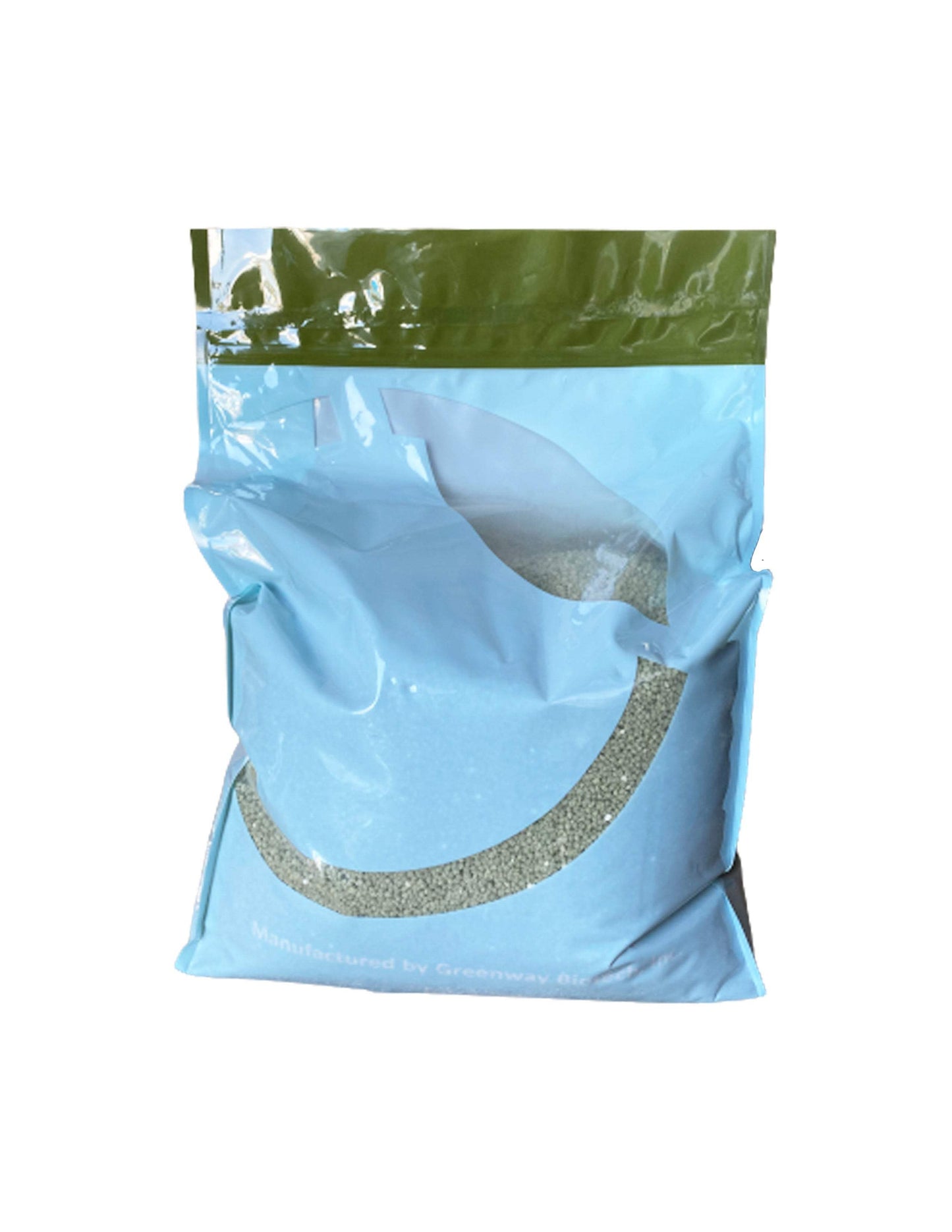
Boost root development, flowering, and fruit set with professional-grade granular MAP 11-52-0 — a high-phosphorus fertilizer for direct soil application.
High-analysis phosphorus source — more concentrated than many natural phosphorus fertilizers such as bone meal, making it an efficient choice for soil applications where phosphorus is the limiting nutrient.
Nitrogen in ammonium form is held on soil cation exchange sites, resisting leaching while supporting vegetative growth without over-pushing leaf production at the expense of flowering.
Uniform granules are designed for even spreading and soil application, making MAP 11-52-0 practical for broadcasting, banding, side dressing, and pre-plant incorporation across a wide range of crop types.
As ammonium nitrifies in the soil, it can contribute to localized acidifying effects in the root zone — which may help support phosphorus availability in alkaline soils where high pH reduces nutrient solubility.
Suitable for broadcasting, side dressing, banding, and pre-plant incorporation — compatible with spreader equipment for large-scale field applications.
Effective across vegetables, fruit trees, ornamentals, lawns, and commercial field crops including corn, soybeans, cotton, and small grains.
Available in 2, 5, 10, 25, and 50 lb sizes — scaled for home garden plots through commercial orchard and field programs.
Independently lab tested for heavy metal content so you can apply with confidence in food gardens and commercial growing operations.
Registered with the California Department of Food and Agriculture (CDFA) and meets all state labeling and nutrient analysis requirements.
The same quality specification used by commercial growers and agricultural operations — available in sizes suited to home gardens and large-scale farms alike.
MAP 11-52-0 granular is produced by reacting anhydrous ammonia with phosphoric acid, then granulating the resulting monoammonium phosphate salt into uniform particles. This granulation process distinguishes it from the water-soluble powder grade and is designed exclusively for direct soil application.
Agricultural-grade granular MAP — the source of both the 11% ammoniacal nitrogen and 52% available phosphate (P₂O₅). Granulation creates uniform particles for mechanical spreading and even soil distribution.
MAP 11-52-0 is formulated to deliver a concentrated phosphorus charge to the soil with a supporting dose of ammoniacal nitrogen. The ratio is designed specifically for root development, bloom initiation, and fruit set — the plant functions most dependent on phosphorus availability.
Ammonium nitrogen (NH₄⁺) is held on soil cation exchange sites, resisting leaching while supporting steady vegetative growth. Ammonium nutrition may contribute to localized acidifying effects as nitrification occurs, which can support phosphorus availability in high-pH soils.
Phosphorus is essential for ATP energy transfer, root elongation, cell division, and reproductive development. At 52% P₂O₅, MAP delivers a concentrated phosphorus source that supports bloom production, fruit set, and root branching.
MAP contains no potassium, allowing precise nutrient control when potassium levels are already adequate or when phosphorus-only supplementation is the goal. Pair with Potassium Sulfate 0-0-53 for complete macronutrient coverage.
Granules dissolve into the soil profile as irrigation or rainfall moves through, releasing phosphorus progressively rather than delivering it in a single liquid application. This supports phosphorus availability over time in the soil.
Because phosphorus moves slowly through soil, granule placement relative to the root zone matters. Banding or side dressing puts phosphorus where roots are actively growing and can intercept it most efficiently.
Uniform granule size allows consistent distribution through rotary broadcast spreaders and drop spreaders — reducing application variability compared with powdered fertilizers.
Results vary with soil temperature, moisture, soil pH, existing phosphorus levels, and application method. A soil test before application is recommended for best outcomes.
MAP 11-52-0 is designed for direct soil application. Water in thoroughly after application. Base phosphorus applications on soil test results when possible — overapplication of phosphorus beyond soil need does not improve plant performance and may contribute to nutrient runoff.
| Crop Type | Rate per 100 sq ft | Method |
|---|---|---|
| New Garden Beds | 5–10 lbs | Till into top 6" |
| Vegetables (General) | 3–5 lbs | Till or rake in before planting |
| Root Vegetables | 4–6 lbs | Incorporate at bed preparation |
| Pre-Plant Field | 200–400 lbs/acre | Incorporate before planting |
| Crop Type | Rate per 100 sq ft | Timing |
|---|---|---|
| Tomatoes / Peppers | 3–5 lbs | At first flowering |
| Fruiting Vegetables (General) | 2–4 lbs | 4–6" from plant stem |
| Flowering Plants / Annuals | 2–3 lbs | Before bud formation |
| Heavy Feeders | 5–8 lbs | Split into 2–3 applications |
| Tree Size | Rate per Tree | Method |
|---|---|---|
| Young / Small Trees (under 4"trunk diameter) | 3–5 lbs | Spread at drip line, scratch in, water deeply |
| Mature Trees (4"+ trunk diameter) | 5–8 lbs | Spread under full canopy, water deeply |
| Orchard Floor (broadcast) | 200–300 lbs/acre | Incorporate or water in thoroughly |
| Application | Rate | Notes |
|---|---|---|
| Established Lawns | 2–4 lbs/100 sq ft | Water in immediately and thoroughly |
| New Lawn Establishment | 5–8 lbs/100 sq ft | Incorporate before seeding or sodding |
| Bag Size | At 3 lbs/100 sq ft | At 5 lbs/100 sq ft | At 300 lbs/acre |
|---|---|---|---|
| 2 lb | ~67 sq ft | ~40 sq ft | — |
| 5 lb | ~167 sq ft | ~100 sq ft | — |
| 10 lb | ~333 sq ft | ~200 sq ft | — |
| 25 lb | ~833 sq ft | ~500 sq ft | — |
| 50 lb | ~1,667 sq ft | ~1,000 sq ft | ~0.17 acre |
For tomatoes, peppers, and squash, side dress with 3–4 lbs per 100 sq ft when first flowers appear. This places phosphorus in the root zone exactly when the plant is transitioning into reproductive growth — many growers notice more consistent fruit set and reduced flower drop when phosphorus is readily available at this stage.
| Method | Compatible |
|---|---|
| Broadcast spreading | ✅ Yes |
| Side dressing | ✅ Yes |
| Pre-plant incorporation | ✅ Yes |
| Banding | ✅ Yes — keep away from seed contact |
| Fertigation / drip injection | ❌ No — use MAP 12-61-0 |
| Foliar spray | ❌ No — use MAP 12-61-0 or MKP 0-52-34 |
| Hydroponics / solution culture | ❌ No — use water-soluble grades only |
Refer to the Safety Data Sheet (SDS) for complete safety information.
MAP 11-52-0 delivers phosphorus and a supporting dose of ammoniacal nitrogen. Complete your fertilizer program with these complementary products for balanced nutrition:
MAP has 0% potassium — add K for fruit quality, disease resistance, and overall plant vigor. Sulfate form avoids chloride buildup.
EssentialAdditional nitrogen plus calcium for cell wall strength and blossom end rot prevention. Provides nitrate-N to balance MAP's ammonium-N. Apply separately — do not mix directly with MAP.
RecommendedMagnesium for chlorophyll production and phosphorus uptake support. Especially valuable in sandy soils or where magnesium deficiency is suspected.
AlternativeNeed fertigation or foliar phosphorus? Use the water-soluble grade instead — 61% P₂O₅ and formulated for complete dissolution in liquid feeding systems.
OptionalAddress iron deficiency — especially relevant in alkaline soils. EDTA chelation keeps iron plant-available across a wide pH range.
OrganicOrganic phosphorus source with calcium — a natural complement for mixed programs where slower P release with calcium benefit is preferred.
MAP 11-52-0 (this product) is a granular form designed for direct soil application — broadcasting, side dressing, banding, and pre-plant incorporation. Granules dissolve into the soil profile after irrigation or rainfall.
MAP 12-61-0 is a 100% water-soluble powder with 61% available phosphate (P₂O₅), formulated for complete dissolution in water. Use it for fertigation, foliar feeding, and hydroponic systems where a liquid-soluble phosphorus source is required.
For a deeper comparison, see our guide on choosing the best phosphorus fertilizer.
No. This granular grade is intended for soil application rather than liquid feeding. It is not formulated for complete dissolution in water and should not be used in fertigation systems, drip injectors, or stock tanks — undissolved material can clog equipment. For fertigation or foliar spraying, use our MAP 12-61-0 (Water Soluble) instead.
Vegetables: Work into soil before planting, then side dress when plants begin flowering. For root crops, apply at bed preparation.
Fruit trees: Apply in early spring before bud break, and optionally post-harvest to restore nutrient reserves. Split applications for young trees — 2–3 smaller doses are preferred over one large application.
Ornamentals: Spring bloomers benefit from fall application; summer bloomers from early spring application.
Lawns: Cool-season grasses in early fall, warm-season grasses in late spring. Incorporate before seeding for new lawns.
Over time, yes — the ammoniacal nitrogen in MAP can contribute to gradual soil acidification as nitrification occurs. This may be beneficial in alkaline soils (pH 7.5+) where high pH reduces phosphorus and micronutrient availability. In already acidic soils (below pH 6.0), monitor pH periodically and apply lime if needed. A soil test before application is always recommended.
Calcium and phosphate ions react when in direct concentrated contact, forming insoluble calcium phosphate that reduces the availability of both nutrients. Apply them at separate times or in separate passes, and allow irrigation water to move them independently through the soil. For crops with high calcium demand — tomatoes, peppers, squash — apply calcium nitrate as a separate side dress or foliar application. Learn more in our article on the function of phosphorus in plants.
Coverage depends on application rate and method. General guidelines:
Use the MAP 11-52-0 Calculator above for precise amounts based on your area and crop type.
Crops with high phosphorus demands see the most benefit: flowering annuals (petunias, marigolds, zinnias), bulbs (tulips, daffodils), roses, fruiting vegetables (tomatoes, peppers, squash, melons), root vegetables (potatoes, carrots, beets, onions), and commercial crops (corn, soybeans, cotton, tree fruits). For more information, see our article on fertilizers that improve fruit yield.
Note: Phosphorus-sensitive plants such as proteas and grevilleas should receive reduced rates or phosphorus-free alternatives.
See how MAP 11-52-0 compares to other common phosphorus sources for soil application.
| Feature | MAP 11-52-0 (This Product) | MAP 12-61-0 | Triple Super Phosphate 0-46-0 | Bone Meal 3-15-0 |
|---|---|---|---|---|
| Available Phosphate (P₂O₅) | 52% | 61% | 46% | 15% |
| Nitrogen | 11% ammoniacal | 12% ammoniacal | 0% | 3% organic |
| Form | Granular — soil application only | Water-soluble powder | Granular — soil application only | Granular — soil application only |
| Application Method | Broadcast, side dress, incorporate | Fertigation, foliar, hydroponics | Broadcast, incorporate | Incorporate, top dress |
| Dissolution | Gradual — dissolves with soil moisture | Immediate — fully water-soluble | Moderate | Very slow (months) |
| pH Effect | Gradual acidifying tendency ↓ | Gradual acidifying tendency ↓ | Neutral | Slightly alkaline ↑ |
| Organic Certified | No | No | No | Yes (OMRI eligible) |
| Best For | Soil-applied P for gardens, orchards, field crops | Liquid feeding systems, hydroponics | Phosphorus-only soil applications | Organic programs, slow-release P with Ca |
If you're not completely satisfied with your purchase, we offer a 90-day money-back guarantee. Simply return the unused portion in its original packaging and we'll process a full refund — no questions asked.
1% of all profits go to our foundation, focused on improving educational opportunities for children.
Family-owned since 1989. Based in Madera, California, we've been making professional-grade fertilizers and soil amendments available to home gardeners and commercial growers alike for over 35 years.
Check out our full FAQ page or contact our experts for personalized advice.
Couldn't load pickup availability