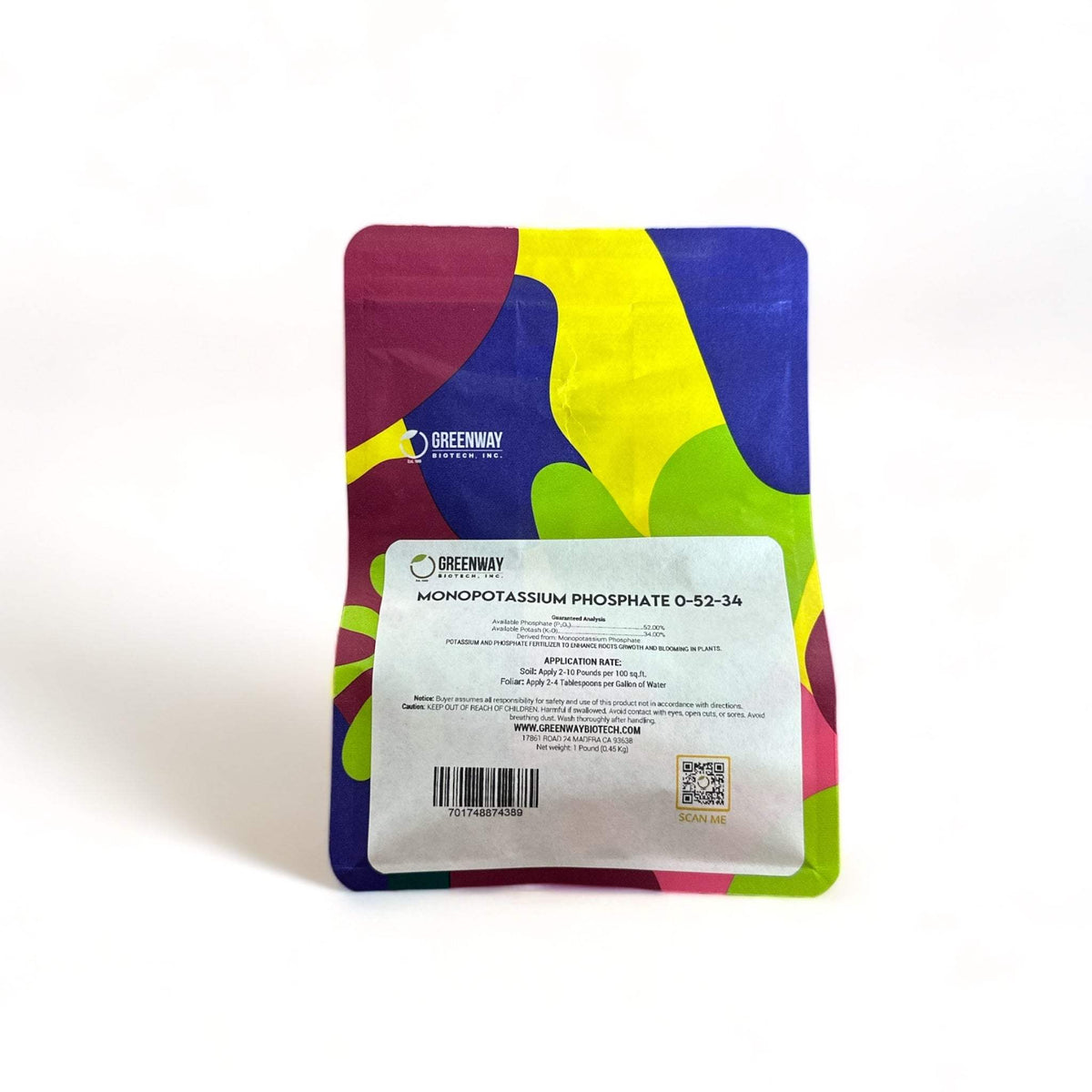
A nitrogen-free, 100% water-soluble P-K fertilizer delivering 52% available phosphate (P₂O₅) and 34% soluble potash (K₂O) — purpose-built for flowering, fruiting, and quality enhancement in soil and hydroponic systems.
MKP contains absolutely no nitrogen, preventing unwanted vegetative growth during critical flowering and fruiting stages when blooms and fruit quality take priority.
One of the highest available phosphate concentrations in a water-soluble fertilizer, driving root development, flower bud initiation, and energy transfer throughout the plant.
High potassium can significantly improve fruit size, sweetness, color, and shelf life while supporting disease resistance and drought tolerance across a wide range of crops.
Dissolves completely and rapidly with no residue, making it ideal for drip irrigation, fertigation lines, foliar sprayers, and recirculating hydroponic systems without clogging emitters.
MKP's low salt index makes it safer for sensitive crops and seedlings compared to other high-phosphorus fertilizers, reducing the risk of fertilizer burn at recommended rates.
Research suggests MKP solutions applied as a foliar spray may help suppress powdery mildew in susceptible crops including grapes, cucumbers, melons, and roses as part of a broader disease management program.
Produced to technical grade standards with consistent crystalline form, superior solubility, and independently tested for heavy metals — with results consistently well below required limits.
At typical use dilutions, MKP has minimal impact on growing medium or nutrient solution pH — making it more compatible with a broader range of crops and growing media than ammonium-based phosphates like MAP or DAP.
CDFA-registered for use on fruits, vegetables, grains, turf, ornamentals, and hydroponic systems — one versatile P-K source across your entire operation.
Manufactured and packaged in California with strict quality controls, CDFA registration, and consistent nutrient analysis backed by third-party laboratory verification.
Greenway Biotech MKP 0-52-34 is derived from a single, pure source compound. Technical grade ensures maximum solubility, purity, and consistency batch to batch.
Because MKP is a single-compound fertilizer, it contains no filler ingredients, binders, or added materials — what you see on the label is exactly what's in the bag.
MKP's formula is derived entirely from one compound — potassium dihydrogen phosphate (KH₂PO₄). With zero nitrogen, it delivers maximum available phosphate (P₂O₅) and soluble potash (K₂O) exactly when plants need them most: during bloom initiation, flowering, and fruit development.
No nitrogen means no stimulus for vegetative leaf growth during bloom. This is the key advantage of MKP over MAP or DAP: it is unlikely to delay flowering, extend the vegetative phase, or dilute fruit quality with excess canopy growth.
Phosphorus drives ATP energy production, root cell division, and flower bud initiation. At 52% P₂O₅, MKP delivers a concentrated dose precisely when phosphorus demand peaks — from bud break through early fruit set.
Potassium regulates stomatal opening, sugar translocation into fruit, and enzyme activation. Adequate potassium during ripening is associated with improved Brix (sugar content), firmer fruit, better color development, and longer post-harvest shelf life.
MAP contains 11–12% nitrogen and no potassium. MKP has zero nitrogen and adds 34% soluble potash (K₂O) — making it the better choice for late bloom and fruit development when nitrogen suppression and quality enhancement are the goals.
As a single-compound fertilizer, MKP has no incompatible components within itself. At typical use dilutions, its minimal pH impact prevents the acidification issues associated with ammonium-based phosphates like MAP and DAP.
The phosphorus-potassium combination in MKP strengthens plant cell walls and supports secondary metabolite production, which research associates with potentially improved resistance to powdery mildew and other fungal pathogens.
| Crop Type | Rate per Acre | Rate per 1,000 sq ft | Timing |
|---|---|---|---|
| Deciduous Fruits (Apples, Pears, Stone Fruits) | 5–10 lbs | 2–4 oz | Pre-bloom & post-bloom |
| Tomatoes, Peppers | 5–10 lbs | 2–4 oz | Prior to full bloom; repeat 2–3× at 2–3 week intervals |
| Grapes | 3–10 lbs | 2–4 oz | Pre-bloom, post-bloom, 30 days before harvest |
| Strawberries | 3–10 lbs | 2–4 oz | After first blooms appear |
| Melons, Cucumbers, Cucurbits | 5–10 lbs | 2–4 oz | Just prior to bloom; repeat 2+ times |
| Potatoes | 5–10 lbs | 2–4 oz | At initial tuber formation |
| Root Vegetables (Carrots, Beets) | 5–10 lbs | 2–4 oz | Mid-season applications |
| Leafy Vegetables, Cole Crops | 1–2 lbs | 0.5–1 oz | Every 10–14 days |
| Small Grains (Wheat, Barley) | 2–6 lbs | 1–2 oz | At tillering, before boot stage |
| Almonds, Walnuts, Pistachios | 5–10 lbs | 2–4 oz | 3–4 applications: petal fall through hull split |
| Application Method | Concentration | Frequency |
|---|---|---|
| Drip Irrigation / Fertigation | 1–2 lbs per 100 gallons | Weekly during bloom/fruiting |
| Hydroponics — Bloom Phase | 100–200 ppm | Continuous in nutrient solution |
| Soil Drench (home garden) | 1 tbsp per gallon water | Every 2 weeks |
| Field Fertigation | 25–500 lbs per acre | Per crop program |
| Application | Rate | Timing |
|---|---|---|
| Cool Season Grasses (Bentgrass, Fescue, Bluegrass) | 2–4 oz per 1,000 sq ft | Spring & fall; up to weekly |
| Warm Season Grasses (Bermuda) | 2–4 oz per 1,000 sq ft | Late spring to early fall |
| Trees, Shrubs, Roses, Bedding Plants | 1 lb per 10 gallons water | At bloom, spring push, or after transplanting |
| Bag Size | Foliar Coverage (at 3 lbs/100 gal) | Fertigation Coverage (at 1 lb/100 gal) |
|---|---|---|
| 1 lb | ~33 gallons spray solution | ~100 gallons drip solution |
| 5 lbs | ~165 gallons spray solution | ~500 gallons drip solution |
| 25 lbs | ~830 gallons spray solution | ~2,500 gallons drip solution |
| 50 lbs | ~1,650 gallons spray solution | ~5,000 gallons drip solution |
For maximum impact on fruit quality and yield, apply MKP foliar at 3–5 lbs per 100 gallons starting 7–10 days before anticipated first bloom, again at full bloom, and once more at early fruit set. This three-application window aligns with peak phosphorus demand for flower development and early cell division in the fruit. Many commercial growers add a fourth application 30 days before harvest to support final Brix development in grapes and tree fruits.
Refer to the Safety Data Sheet (SDS) for complete emergency and handling information.
MKP delivers pure P and K with zero nitrogen. Pair it with these products to build a complete fertility program for every growth stage.
Provides nitrogen and calcium — two nutrients absent in MKP. Apply on separate fertigation days to avoid calcium-phosphate precipitation.
21% nitrogen plus sulfur for vigorous vegetative growth phases. Use before switching to MKP at bloom transition.
Supplies magnesium for chlorophyll production and sulfur for enzyme function. Compatible with MKP in the same tank.
Corrects iron deficiency in bloom-stage crops without interfering with MKP's P-K delivery. EDTA chelation keeps iron plant-available across a wide pH range.
Phosphate ions (from MKP) and calcium ions react to form calcium phosphate, an insoluble compound that precipitates out of solution. The resulting white sludge can clog drip emitters, spray nozzles, and pump filters. Always apply MKP and calcium fertilizers on separate fertigation cycles — a 24-hour gap between applications is sufficient for most systems.
MAP (monoammonium phosphate) contains 11–12% nitrogen alongside high phosphorus and no potassium. MKP contains zero nitrogen and adds 34% soluble potash (K₂O). Choose MKP when you are at the flowering or fruiting stage and need to boost P and K without stimulating new vegetative growth. Choose MAP 12-61-0 when you need phosphorus along with some nitrogen during early growth or root establishment.
Research suggests that MKP solutions applied as a foliar spray may help suppress powdery mildew on susceptible crops including grapes, cucumbers, melons, and roses. The phosphorus-potassium combination can strengthen plant cell walls and support immune response. MKP is often used alongside systemic fungicides to potentially improve overall program efficiency — though results vary by crop, environment, and disease pressure.
Follow the temperature guidelines strictly: stop foliar spraying when air temperature reaches 84°F on a rising curve (typically mid-morning), or wait until temperatures fall to 90°F on a falling curve (late afternoon). Always maintain a minimum 7 days between foliar applications and never spray stressed plants. Using sufficient water volume — targeting 350 gallons per acre for dilute sprays — helps prevent excessive concentration on leaf surfaces. Adding a non-ionic surfactant can also improve coverage and reduce localized concentration.
MKP is typically most valuable from bud break through early fruit set — specifically the 2-week window before first bloom, during active flowering, and at fruit set when phosphorus demand is highest. For quality enhancement, a final application 30 days before harvest can help increase Brix and improve color in grapes and stone fruits. MKP is generally less useful during the purely vegetative stage when nitrogen and micronutrients take priority over P-K loading.
MKP is compatible with most water-soluble fertilizers (except calcium sources), micronutrient chelates, most fungicides, and many insecticides. Its slightly acidic character in concentrated solution can actually enhance the efficacy of some pH-sensitive pesticides. Always perform a jar test before full-scale tank mixing: combine small amounts of each product, wait 15 minutes, and check for precipitation, gelling, color change, or heat generation before scaling up.
If you're not completely satisfied with your purchase, return the unused portion in its original packaging within 90 days for a full refund. No questions asked. See our Returns & Shipping page for details.
1% of all profits support the Greenway Foundation, focused on improving educational opportunities for children. Learn more at greenway.foundation.
Couldn't load pickup availability