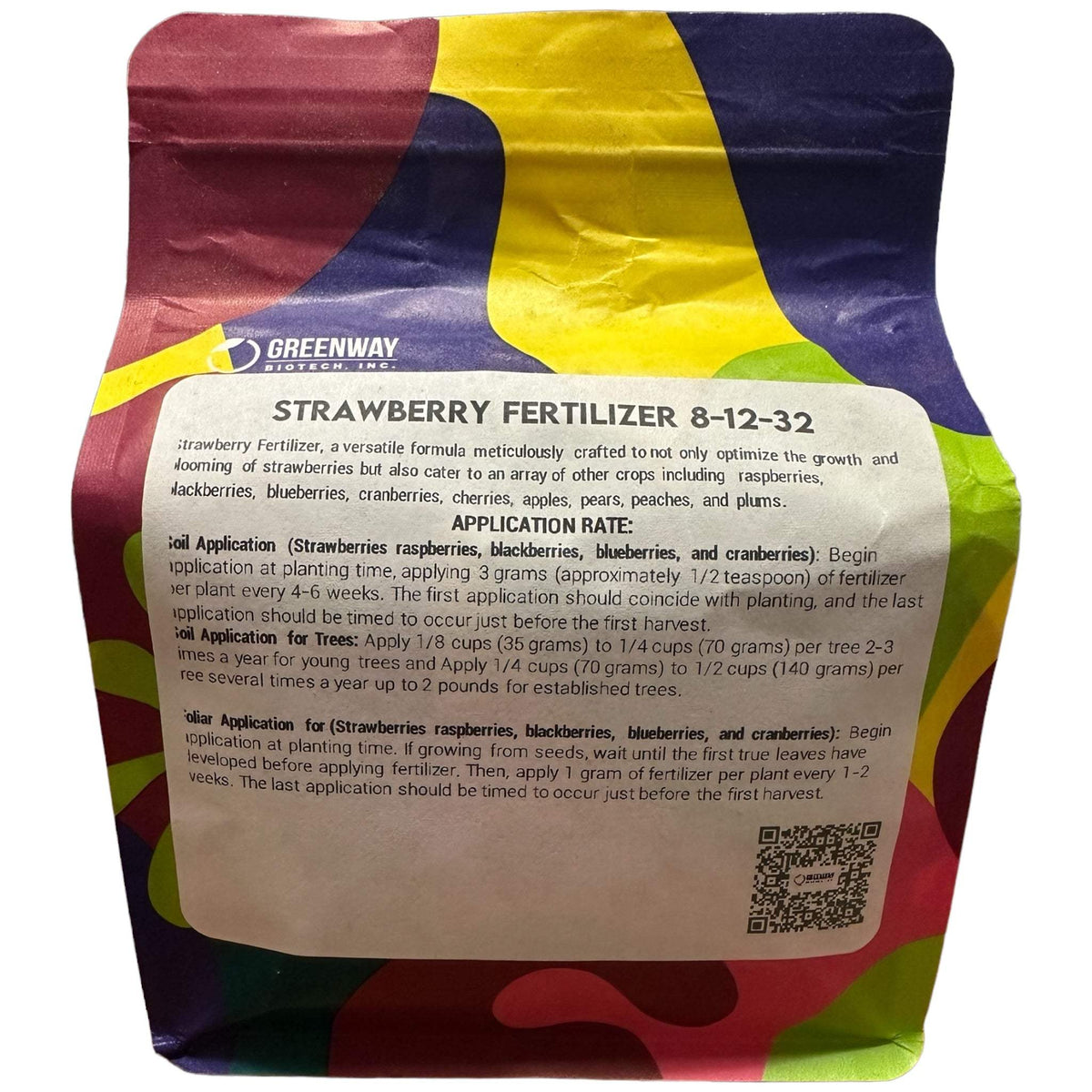
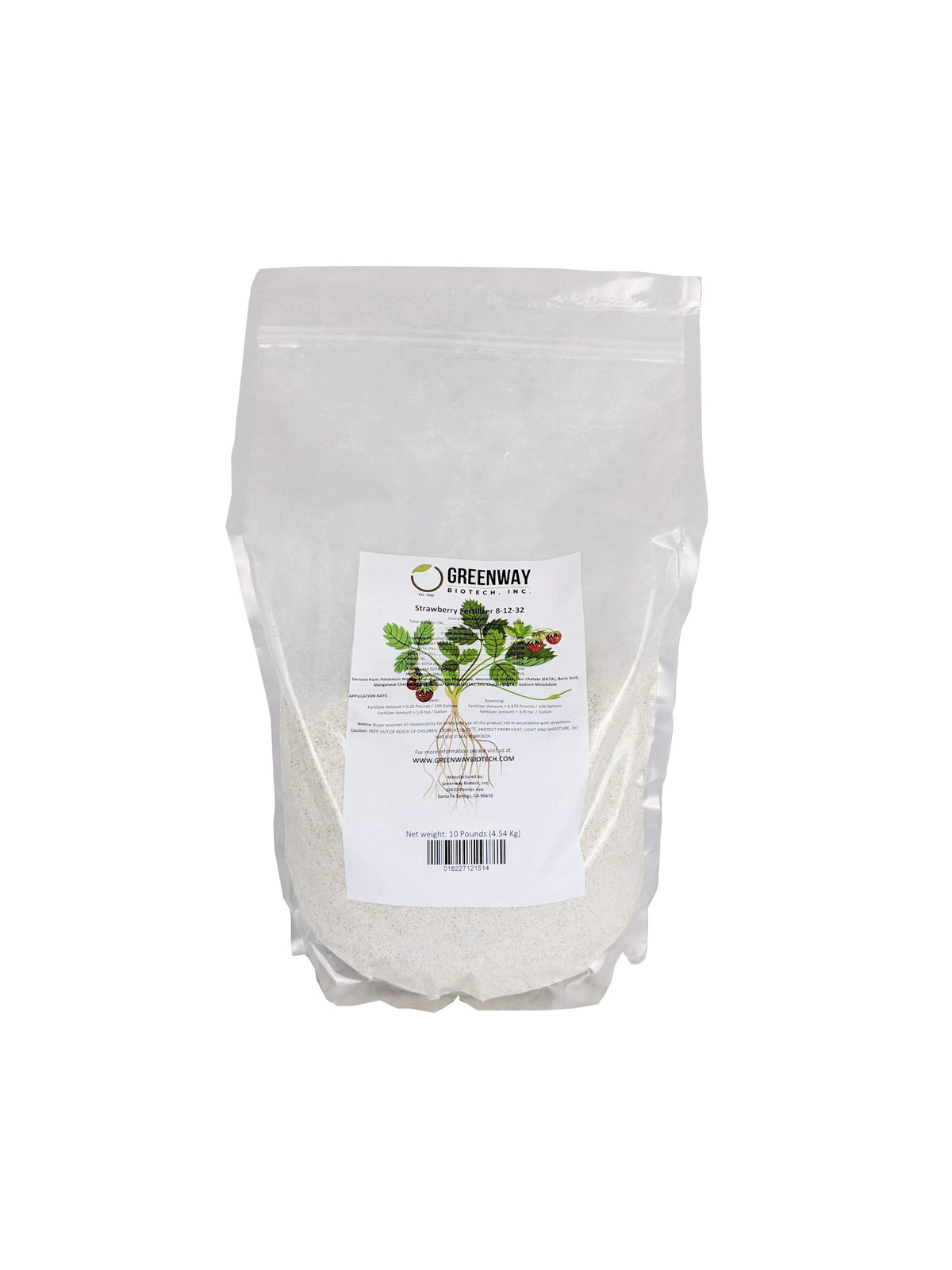
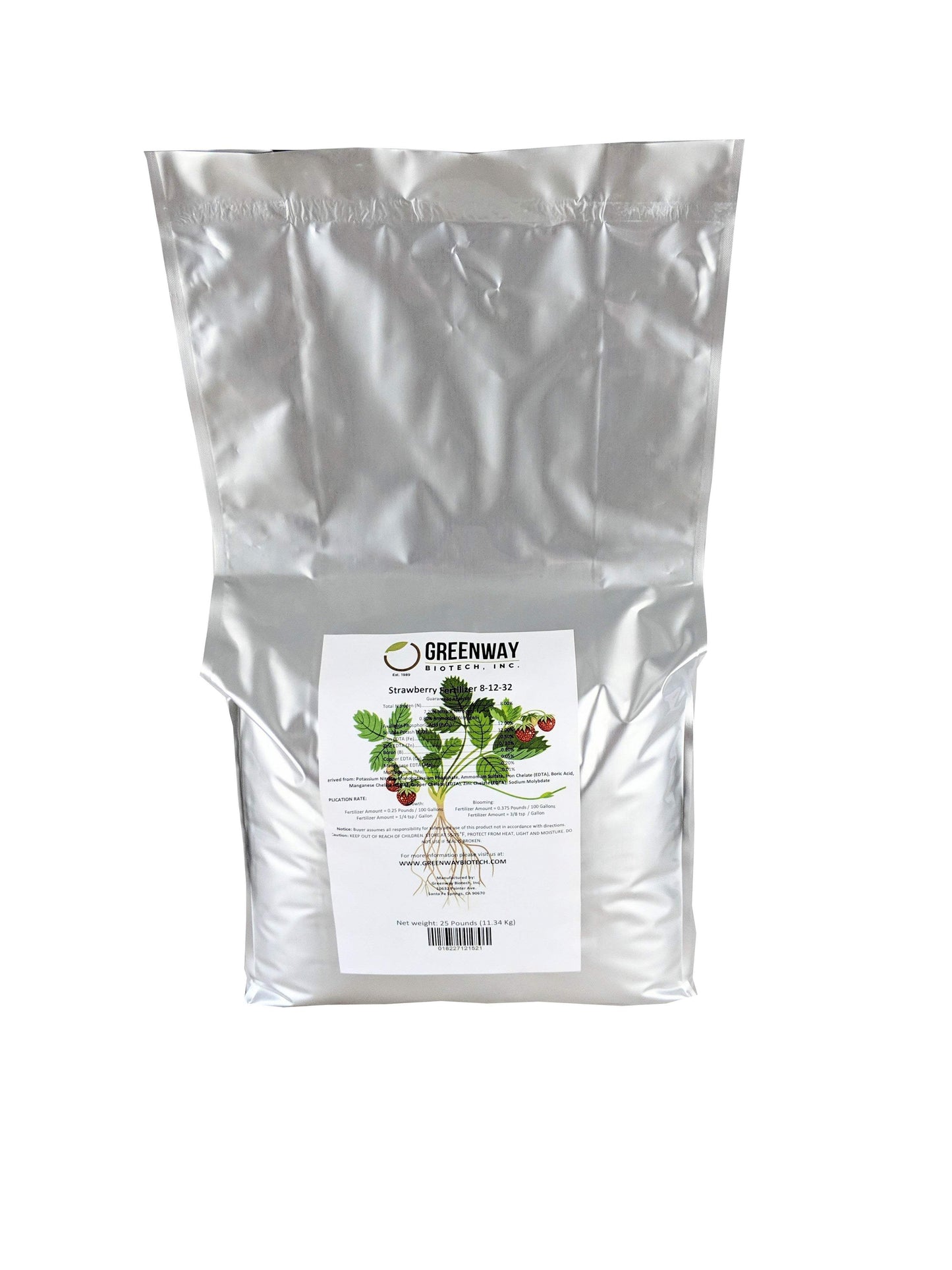
Grow sweeter, larger, and more abundant strawberries with our premium water-soluble 8-12-32 formula. Scientifically balanced for strawberries with EDTA-chelated micronutrients for soil, hydroponic, and foliar growing.
Best for strawberries during flowering and fruiting. Works in soil, raised beds, containers, drip irrigation, and all hydroponic systems. Designed to support sweetness, firmness, and berry size when used as part of a complete nutrition program.
Moderate nitrogen prevents excessive foliage while ultra-high potassium (32%) supports sugar movement and fruit development for sweeter, firmer berries when paired with proper light, irrigation, and harvest timing.
Iron, manganese, zinc, and copper are protected by EDTA chelation, helping reduce micronutrient tie-up and supporting availability across a wider pH range than non-chelated forms.
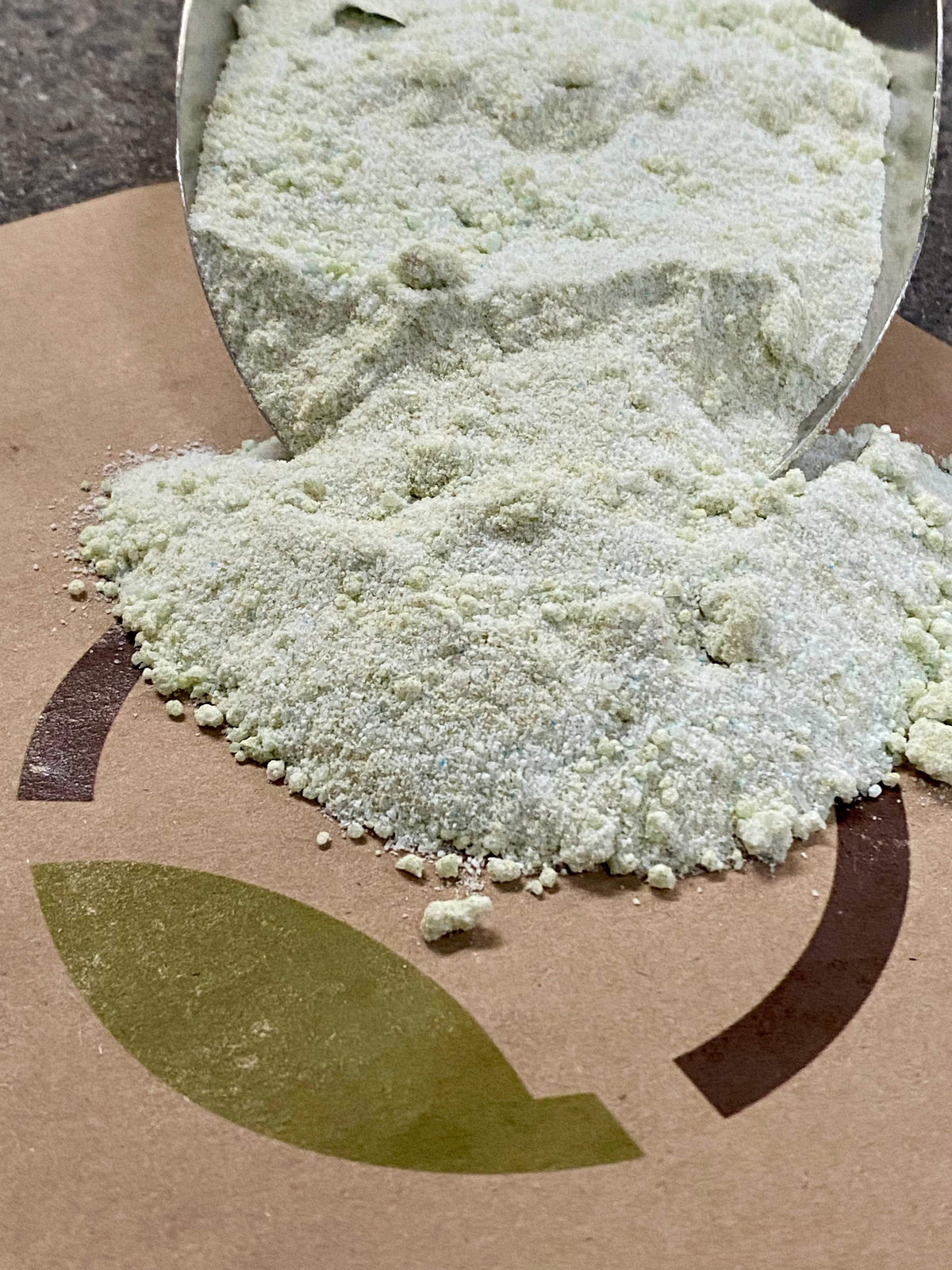
Dissolves completely in room-temperature water with zero residue. Compatible with drip irrigation, hydroponic towers, NFT systems, DWC, Dutch buckets, and foliar sprays.
Every batch independently tested by third-party laboratories with results consistently well below required limits. CDFA registered for professional and home grower confidence.
Purpose-built for strawberries — not a generic berry fertilizer. Blueberries require a very different pH and nitrogen program. This formula is tuned to the specific macronutrient ratios and pH preferences of strawberry crops.
High potassium improves cell expansion and water regulation for larger, more uniform berries with better market appeal and consumer satisfaction.
The 32% potassium content can support sugar movement to developing fruit, which may help improve Brix levels for noticeably sweeter, more flavorful berries when crop conditions are well managed throughout the harvest.
Proper potassium and calcium supplementation produces firmer berries that resist bruising, improving post-harvest quality and reducing losses during shipping.
Enhanced phosphorus (12%) ensures strong crown development, abundant flowering, and excellent fruit set across all growth stages from establishment through heavy fruiting.
Includes boron for proper pollination and fruit shape, plus molybdenum for nitrogen metabolism — a complete nutritional package beyond just NPK.
Our formula is blended from premium-grade, solution-grade raw materials — each chosen for purity, solubility, and plant availability.
Provides phosphorus and potassium in one compound. Drives flowering, root development, and fruit set.
Chloride-free potassium source preferred for berry crops. Also supplies sulfur for enzyme activation and flavor compounds.
Provides ammonium nitrogen and sulfur. Slightly acidifying effect benefits berry crops that prefer lower pH.
EDTA-protected iron for chlorophyll synthesis and berry color development. Stays available even in alkaline conditions.
EDTA-chelated manganese for disease resistance, photosynthesis support, and improved fruit uniformity.
EDTA-protected zinc for auxin production, protein synthesis, and proper berry formation and seed development.
EDTA-chelated copper for lignin synthesis, cell wall strength, and enhanced berry firmness and disease resistance.
Mineral-form boron critical for cell wall formation, calcium utilization, pollination, and preventing misshapen berries. Not chelated.
Mineral-form molybdenum that supports nitrate metabolism and efficient nitrogen use. Not chelated.
Our formula addresses the unique nutritional demands of strawberries and berry crops throughout their growth cycle — moderate nitrogen to prevent excessive foliage, enhanced phosphorus for prolific flowering, and ultra-high potassium to support sugar movement and fruit quality.
Strawberries need sufficient nitrogen for healthy leaf growth and runner production, but excess nitrogen causes soft berries, reduced sugar content, delayed ripening, and excessive vegetation at the expense of fruiting. Our 8% level hits the sweet spot.
During crown development, flowering, and fruit set, strawberries have elevated phosphorus demands. The 12% level supports strong root systems, ATP energy transfer, abundant flower production, and improved berry development.
Strawberries are heavy potassium feeders, especially during fruiting. This dominant 32% level supports sugar movement to developing fruit, helps regulate water balance for firm berries, is involved in activating more than 60 enzyme systems, and can significantly enhance photosynthesis.
Chelated EDTA. Essential for chlorophyll synthesis and photosynthesis. Prevents interveinal yellowing and supports healthy pigment development in developing berries.
Chelated EDTA. Activates enzymes involved in photosynthesis and nitrogen metabolism. Supports normal plant metabolism, pollen viability, and berry uniformity.
Chelated EDTA. Required for auxin production and protein synthesis. Essential for proper berry formation, seed development, and preventing small leaves.
Chelated EDTA. Involved in lignin synthesis for strong cell walls. Supports enzyme function, overall plant structural integrity, and berry firmness.
Boric Acid (mineral form — not chelated). Critical for cell wall formation, calcium utilization, and pollination. Prevents misshapen berries and ensures proper flower development and fruit set.
Sodium Molybdate (mineral form — not chelated). Supports nitrate metabolism and efficient nitrogen use. Though needed in tiny amounts, deficiency causes yellowing and poor overall growth.
Potassium supports sugar movement and accumulation in developing fruit, which can improve Brix levels for sweeter, more flavorful strawberries when other growing conditions are well managed.
Improves cell expansion and water uptake for bigger, more uniform berries with better market appeal.
Maintains berry firmness and reduces post-harvest deterioration, bruising, and shrinkage during storage and shipping.
Adequate potassium can support stronger cell wall integrity, which may contribute to improved plant resilience against common fungal and environmental stressors during the growing season.
Enhances anthocyanin production for deep red color development throughout the berry, improving visual quality.
Helps plants cope with temperature extremes, drought stress, and environmental fluctuations during critical fruiting periods.
Below are recommended rates for strawberries. Start at the lower end and increase based on plant response. Rates for hydroponic applications assume RO or rainwater — reduce Cal-Mag Plus by 30–50% if using tap or well water with 30+ ppm calcium.
| Growth Stage | 8-12-32 Amount | Cal-Mag Plus Stock | pH Range | Target EC (PPM 500 / 700) |
|---|---|---|---|---|
| Establishment | 0.25 lbs | 250–500 ml | 5.8–6.2 | 0.8–1.0 EC (400–500 / 560–700) |
| Vegetative Growth | 0.4–0.5 lbs | 500–1,000 ml | 5.6–6.0 | 1.2–1.4 EC (600–700 / 840–980) |
| Flowering/Fruiting | 0.5–0.6 lbs | 1,000–1,500 ml | 5.6–6.0 | 1.4–1.6 EC (700–800 / 980–1,120) |
Strawberries are EC-sensitive — do not exceed 1.6 EC during fruiting. High EC reduces flavor (lower Brix, more acidic) and increases leaf-margin burn. EC up to 1.8–2.0 may be used under cool, high-light conditions only.
PPM/TDS readings depend on your meter's conversion scale. 500-scale PPM = EC × 500 | 700-scale PPM = EC × 700. Most Hanna and HM Digital meters use 500-scale. Most Bluelab meters report EC directly.
Cal-Mag Plus stock is prepared by dissolving the entire 5 lb bag in 2 gallons of water; doses above are ml of that prepared stock per 100 gallons of reservoir.
On reverse-osmosis or rainwater, Calcium Nitrate is recommended to ensure adequate calcium for fruit firmness and shelf life. On tap water with 30+ ppm Ca it is optional.
Pre-dissolve Calcium Nitrate separately and add to the reservoir first, then Cal-Mag Plus stock, then 8-12-32. Never combine in concentrate.
| Purpose | 8-12-32 Rate | Frequency / Notes |
|---|---|---|
| Pre-bloom push | 0.75 lb / 100 gal | Once, 10 days before first flower; spray to glistening. Can add Cal-Mag stock 5 ml/gal to tank. |
| Runner production support | 0.5 lb / 100 gal | Every 10 days during runner production; light spray only. Add Cal-Mag stock 5 ml/gal if plants show stress. |
| Deficiency correction | 1.0–1.5 lb / 100 gal (MAX) | Every 7 days, max 2 sprays; stop 14 days before harvest; test small area first. Add Cal-Mag stock 5–10 ml/gal to tank. |
| Application | Rate | Timing |
|---|---|---|
| Pre-plant incorporation | 1 lb / 100 sq ft | Once before bed prep; strawberries prefer pH 5.8–6.5 — do not lime aggressively |
| Side-dress (June-bearers) | 0.25 lb / 100 sq ft | After first flush; repeat after each major harvest cycle |
| Side-dress (everbearers) | 0.25 lb / 100 sq ft | Monthly during the season |
| Drip fertigation | 0.5 lb / 100 gal | Every 2 weeks during fruiting |
| Container plants (at potting) | 0.5 tsp / gallon of soil, mixed in | At potting; top-dress at first flower |
| Soil drench (establishment) | 0.25 lb / 100 gal | At transplant; repeat 2 weeks later |
| Soil drench (vegetative) | 0.5 lb / 100 gal | Every 14 days |
| Soil drench (fruiting) | 0.5–0.75 lb / 100 gal | Every 14 days; use lower end if soil EC is rising |
Avoid heavy nitrogen feeding in fall — it promotes soft new growth that does not harden off before winter, increasing winterkill risk in zones 6 and colder. Taper feeding to biweekly and reduce rate in late summer to early fall.
Establishment (Week 0–4): 0.25 lbs / 100 gal + Cal-Mag 250–500 ml / target 0.8–1.0 EC
Vegetative (Week 4–8): 0.4–0.5 lbs / 100 gal + Cal-Mag 500–1,000 ml / target 1.2–1.4 EC
Flowering (Week 8–10): 0.5–0.6 lbs / 100 gal + Cal-Mag 1,000–1,500 ml / target 1.4–1.6 EC
Fruiting (Week 10+): 0.5–0.6 lbs / 100 gal + Cal-Mag 1,000–1,500 ml / target 1.4–1.6 EC — do not exceed 1.6 EC
For the best flavor, maintain consistent moisture leading up to harvest — avoid overwatering near ripening, but do not stress the plants. Continue full-strength potassium feeding all the way through harvest. Pick berries in the morning when sugar content tends to peak, and allow fruit to fully ripen on the plant before picking. Cool overnight temperatures in the days before harvest can also support sugar accumulation.
Refer to the Safety Data Sheet (SDS) for complete safety information.
Build a complete berry feeding program by pairing 8-12-32 with these essential companions.
Prevents soft berries and tip burn. Critical for fruit firmness, cell wall strength, and shelf life. Required for hydroponic systems.
BoostExtra potassium boost during heavy fruiting to support sweetness, berry size, and sugar accumulation.
SupplementMagnesium for chlorophyll production. Enhances green leaf color, photosynthesis, and overall plant vigor.
Adequate potassium is the nutritional foundation for sweeter berries. The 32% potassium content can support sugar movement to developing fruit, which may help improve Brix levels when other growing conditions are also well managed. Beyond nutrition, ensure 6-8 hours of direct sunlight, maintain consistent moisture leading up to harvest (avoid overwatering near ripening but do not stress plants), and pick fully ripe berries in the morning. Cool nights before harvest can also contribute to better flavor. For a deeper understanding, see our article on What's the Function of Potassium (K) in Plants? For a complete nutrition guide, see What is the Best Fertilizer for Strawberries?
Strawberries prefer slightly acidic conditions. For soil growing, maintain pH 5.8–6.5. For hydroponics, adjust pH by growth stage: establishment at 5.8–6.2, vegetative growth at 5.6–6.0, and flowering/fruiting at 5.6–6.0. Always check pH after mixing nutrients, as fertilizer addition will change the solution pH.
Yes — our formula dissolves completely and works in vertical hydroponic towers, NFT systems, DWC, and Dutch buckets. For flowering and fruiting, use 0.5–0.6 lbs per 100 gallons of reservoir, maintain EC at 1.4–1.6 (700–800 PPM @ 500-scale / 980–1,120 PPM @ 700-scale), keep pH at 5.6–6.0, and always add Cal-Mag Plus at 1,000–1,500 ml per 100 gal. Check EC daily since towers evaporate faster, and top off with plain pH-adjusted water — not nutrient solution — when EC rises. On RO water, add Calcium Nitrate at 0.15–0.30 lbs per 100 gal for fruit firmness.
Everbearing varieties need consistent nutrition for continuous production: start at half strength weekly during spring establishment, increase to full strength for the first crop, reduce to half strength between crops, return to full strength for the second crop, and taper to biweekly in fall. Never skip feeding during active fruiting, and increase Cal-Mag Plus during peak production.
Calcium and phosphorus are chemically incompatible in the same solution — when mixed, they form insoluble calcium phosphate that precipitates out and becomes unavailable to plants. That's why any high-phosphorus fertilizer must be supplemented with a separate calcium source. For more on why calcium matters, see our article on Why Calcium is Crucial for Plant Growth.
Recommended calcium sources:
Our fertilizer is hygroscopic — it absorbs moisture from the air. Keep the bag sealed tight between uses and store in a cool, dry place out of direct sunlight. If the powder clumps, simply break it up. Clumping does not affect the product's efficacy or nutrient content.
This formula is optimized and formulated specifically for strawberries. Do not use it as a general berry fertilizer — blueberries require a very different program (pH 4.5–5.5, ammoniacal nitrogen) and caneberries such as raspberries and blackberries have their own requirements. For strawberry-specific guidance, see our complete article on What is the Best Fertilizer for Strawberries?
Important details on quality, returns, sustainability, and charitable efforts that set our product apart.
If you're not completely satisfied, we offer a 90-day money-back guarantee. Simply return the unused portion in its original packaging, and we'll process a full refund. No questions asked.
We're committed to sustainable practices, including:
1% of all profits go to our foundation, focused on improving educational opportunities for children in agricultural communities.
Check out our full FAQ page or contact our experts for personalized advice.
Couldn't load pickup availability